
Food safety objectives are the goals that your food business sets around producing and providing safe and suitable food to your customers. They can be seen as the guiding principles that you can then build your food safety implementation plans around. Every policy that you develop for your food business should have an associated set of food safety (and quality) objectives.
Developing SMART objectives
Like any type of business objective, food safety objectives should be developed following the SMART acronym. SMART objectives are Specific, Measurable, Achievable, Realistic and Timely. You can develop company-wide objectives or narrow down to individual departments within your food business. Whenever you write the food safety objectives for your food business always check that they cover these five aspects.
- Specific for your food business. Use your business data and target to areas of improvement for your own business.
- Measurable food safety objectives are just that – you should be able to determine compliance to your objective through some type of solid metric. This means that you need to associate actual targets to the objective. I always find that having numerical targets makes it easier to not only report on progress but to also motivate the food handling team towards achieving our goals.
- Achievable. It is no good writing an objective that will never be achieved. Always start of small and in bite sized chunks. You are more likely to succeed this way.
- Realistic objectives are closely aligned to making your food safety objectives achievable. They need to be realistic to your food business not someone else’s.
- Timely objectives motivate us to achieve the outcome. All objectives should have a time limit otherwise nothing ever gets done. Time restrictions are a catalyst for goal achievement. Just remember that “tomorrow never comes”.
Communicating to your team
Once the food safety objectives have been developed make sure that they are communicated to all relevant staff. Communication can be as easy as displaying the food safety objectives on staff notice boards or published on internal intranets to verbal discussion at staff or tool-box meetings. You may want to also implement training to individual departments if you have also developed departmental objectives on top of business-wide objectives.
Examples of food safety objectives
Some examples of food safety objectives include:
- To respond to customer complaints within x hours
- To reduce the number of customer complaints by x% on previous year.
- To maintain a minimum ‘G-rating’ for our third party certification audit.
- To complete all verification activities within 5 days of the scheduled date.
- To complete food safety induction training for new employees before job commencement.
- To ensure that there is no listeria monocytogenes detected in any of x product.
- To maintain a minimum of x% for all internal GMP audits.
- To not have any food recalls during the 2023 year.
- Reduce the number of food safety incidents by 50% within the next six months compared to the same time last year.
- Increase the frequency of employee food safety training sessions in 2023 by 50% compared to 2022.
Just remember to make sure that they are relevant to your food business and you include reporting metrics to suit.
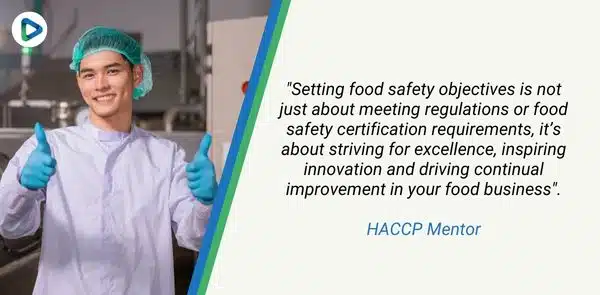
Improving Food Safety Culture
Food safety objectives are a crucial component in maintaining a culture of food safety and quality within any food business. By establishing clear and measurable targets, a business can ensure that food safety and quality is consistently prioritized and maintained.
Defining SMART objectives is a great starting point when developing activities to include in your food safety culture action plans. For example, let’s say we want to design an activity around employee feedback. Your objective could be to “Implement a food safety suggestion program by the end of June 2023 quarter to encourage employees to share suggestions for improving food safety processes.”
Reporting on Outcomes
The most common platform to report on the compliance of your objectives is through the management review process. You can also provide reporting through weekly or monthly team meetings. Always make it clear what your objective is and the result to date. Data graphs are a great way to visually represent your progress and provide a trigger to fix or correct non-compliance before they escalate.
Reviewing Food Safety Objectives
An important part of defining food safety objectives for your food business is including a review process. If during your reporting process you find that some objectives were not met, you need to understand why this was the case. You should investigate the underlying reasons. Completing a review will be helpful when setting future objectives and also facilitate continual improvement.
Share your experience
Have you already set your food safety objectives for this year? Did you meet your objectives in the previous year? Share you experience with the HACCP Mentor community by leaving a comment below.