
It can be a confusing state when you are faced with having to choose what is the best 3rd party food safety certification standard for your food business. In this post, I hope to give you a bit of direction when making this decision. For the sake of argument, I will also refer to ‘customer standards’ as certification standards in this particular post.
What is food safety certification standard?
A Food Safety Certification Standard is generally a voluntary set of rules that a food business can follow to demonstrate their performance. This performance is then assessed by a 3rd party who is objective and impartial to the food business. The outcome of this assessment results in a food business being certified or not certified or it determines if you can trade with a particular customer or not. Keep in mind that just because you have certification to a 3rd party HACCP food safety Standard, does not negate your legal responsibility to comply with any food laws required by your food business.
Why do I need to have food safety certification?
The biggest driver in 3rd party certification is definitely from the customer. When I say ‘customer’, I don’t mean your neighbour, mother or the guy who lives down the road. The ‘customer’ is generally a trading partner. This may be a retailer like McDonalds, Aldi, Woolworths, PepsiCo, Nestle, Walmart or Costco or it could be the food business that buys their raw materials from you. In some areas, it may also be a legal requirement, with governments recognising food safety certification as the basis of legal compliance. Your business may also choose to have certification purely as a means of ensuring business success, risk management and business improvement. Successful certification can then be used in marketing the food business as a point of difference to their competitors. Covering your food safety and quality risks also makes good business sense and keeps your customers happy.
How do I choose the best food safety certification standard for my business?
I have put together this infographic to explain how I make this decision for my clients. It is based on asking and answering three questions.
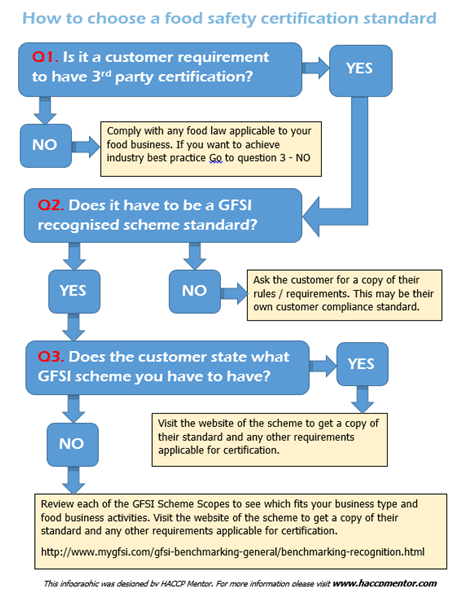
Note: I don’t see that there is much difference between any of the GFSI recognised schemes. This is because all of the schemes are required to comply with benchmarking requirements.
Getting copies of the food safety certification standards
Like any game in life, in order to be truly successful you need to know the rules. It is imperative that you get a copy of the certification standard and know it back-to-front. Knowing the rules and requirements will allow your food business greater success when it comes to certification audits and also allows for robust business practices to be developed and implemented.
Depending on which food safety certification standard you go with, there may be a fee involved in getting a copy of the standard. I have never really understood why standard owners would charge for a copy of the rules considering the level of competition in this marketplace. None the less, visit the website of your proposed standard or check out this article I have written on GFSI Standards.
Same Same but Different
In some parts of the world, a food business may be required to comply with multiple certification standards. In the perfect world this wouldn’t be the case, as all the stakeholders would just agree on one set of rules. Unfortunately, when you actually read these standards, they are generally the same with just a little twist. All food safety and quality standards generally have the foundation of Codex HACCP with the addition of pre-requisite / support programs like pest control, cleaning, allergen management, calibration etc.
To help your food business in developing these programs, I have published several resources available to help with this process. To find out more please click here.
Which certification standard do you have?
Which food certification program does your business have? How did you choose? Share your experience with the HACCP Mentor community by leaving a comment below.



I just want to Learn more about HACCP PLAN that’s why I need to Join a HACCP TRANING PROGRAM. THANKS :)))
You can find out more about our HACCP training at: https://haccpmarketplace.com/product/haccp-principles-and-application-online-training/
I work in food and beverage manufacturing and want to pursue further safety and HACCP certifications, not only because I enjoy learning and having the knowledge but also it’s great to have them under your belt. Thank you!
I totally agree with you Mary Jane. Continuous learning is essential.